Its true video advertisements leave a better impact on the minds of the prospective customers in comparison to other sources of advertisement. A planned and clear video can leave a mark on the minds of the prospective buyers and may lead to revisits and convert prospective customers into genuine customers. These buyers can also act as an indirect brand ambassadors of the product when they share those videos to their groups and provide valuable feedback as a prospective buyers.
The generation born between 1980 and 2000, that’s coming of age now is about as different in terms of behavior as any the world of business has seen. A Pew Research that polled a representative sample of 1,821 adults showed that this is a generation that’s unmoored from institutions, considers itself to be digital natives and does not anchor its identity to religion or ethnicity.
Google research reveals that millennials are quick to use mobile to research productson the fly and are prepared to change their minds when there is sufficient data for them to do so. This is backed by the Pew Research findings that show that this is a generation that’s “Confident. Connected, Open to change”.
Trust, Authority, Authenticity
In truth, any kind of purchasing decision has been made upon the consumer’s assessment of a brand or a product based upon all three: Trust, Authority and Authenticity. So, nothing has changed in that regard. How these are calculated however has undergone a significant change that is still wrongfooting, governments, institutions as well as brands.
Brand-led messages, command-and-control approaches and marketing that’s based upon the status symbol of a purchase are no longer effective or anywhere near enough. When millennials reach out to their social network for reviews or suggestions, look across the web for independent product reviews and check in-depth information regarding the background of products and services top-down marketing tends to only get in their way.
The Age of Meaning
The change in attitudes that’s so unsettling to traditional marketing is also a golden opportunity for those brands that are evolving with the times and those marketers who understand what’s important to their audience.
In a time when attention is more fragmented than ever, gaining it and holding it depends on managing to adequately present your brand through what Google research calls micro-moments. Instances in which a person wants to learn something, wants to check something or wants to do something.
Content that surfaces in a micro-moment is intimately linked to the content creator’s understanding of an audience need and search’s understanding of:
Content meaning
Search query meaning
Searcher intent
The dots that are joined here are driven by semantic technologies, of which semantic search is just one type, across the web and devices.
Stop ‘marketing’, Start Being Useful
Brands that fail to understand that the connection between themselves and their audience is one of practical usefulness will soon fail to find an audience to “buy their stuff”. Millennials are not impressed by fancy logos and sleek websites. Nor do they think that the most authoritative information on a product comes from those who sell it. Brands that get this are already busy changing their approach by:
Focusing on satisfying customer intent rather than making a sale
Creating value that goes beyond their products
Starting conversations on shared interests and values with their audience
Creating connections with potential customers long before the point of the purchasing decision
Establishing an identity and a voice that helps to develop trust between them and their potential audience
All of these, of course, lead to those “three little words”: Trust, Authority, Authenticity. So, nothing has fundamentally changed, yet everything is different.
As the technology advances the market is getting closer from a walking distance to the pockets. The digital marketing is expanding its scope towards mobile friendly sites to let the customer view everything in small size on their smartphone screens. The smartphones are truly engaging the customers thus expanding the opportunities of the business to expand their content with the continuous challenges and wins.
Having a presence on the social websites and regularly updating and sharing information will not be enough to leave a mark in consumers mind. The personal touch in social media is very much needed to engage and get feedback from the customers. The comments and share option on the account acts as a silent boosters for your business. Every single comment or share may it be on an old post can refresh your presence in the digital world and give you opportunity to interact with customers through comments to leave a positive mark on the end customer. For More Details: www.sanicondigital.in
As the largest restaurant chain in the world, McDonald's is no stranger to the effects that digital has had on consumers.
Those who are responsible for using digital to drive people towards those magical Golden Arches have thought of some clever digital marketing campaigns over the past couple of years. These campaigns not only drive footfall to stores, but also help to increase brand loyalty and engagement.
In an age where customers are deserting offline shopping, campaigns that blend the physical and the digital offer an opportunity to connect with digitally-savvy consumers.
We've put together ten examples from across the world where this brand has succeeded. Read below for more...
McDonald's Extended Restaurant Hours
As detailed in this post on location-based mobile campaigns, McDonald's won numerous awards for this particular example to promote new late night opening hours.
A third of McDonald’s outlets had their hours extended at the beginning of the year so needed to raise awareness and drive footfall.
With a majority of its late night customers being shift workers and travellers, it targeted them with ads at cash points and petrol stations encouraging them to download a new Restaurant Finder app.
McDonald’s also bought mobile banner ads to promote the app on websites it knew customers frequented at night.
The result? Over 500,000 visits and an ROI of over 100%.
The Ask McDonald's YouTube campaign
With many members of the public being concerned about the quality and traceability of their food, McDonald's Canada wanted to make sure that customers were informed.
In order to address this, they offered to answer questions from the public about their food.
Over 20,000 questions were asked, of which each one was answered. They also set up aYouTube channel to showcase video responses to some of the questions.
The Track My Macca's App
Another one that addresses issues of food provenance, this campaign was put together by DDB Group Sydney.
Using GPS to find out what restaurant you are in, the app then uses image recognition software to figure out what the customer is eating and then provides a real-time supply chain info for the product about to be eaten.
The app was downloaded over 45,000 times while the PR campaign behind it received over 600m impressions worth of global PR coverage.
McDonald's Monopoly goes digital
A regular marketing campaign that began in 1987, customers playing McDonald's Monopoly previously had to peel off stickers and attach them to a paper board in order to win prizes, ranging from big cash prizes and cars, through to free food.
To catch up with the digital age, the latest product allowed customers to add these stickers to a virtual game board from mobile devices, by entering a unique code from each sticker.
Digital Happy Meals Play Zones
As covered in Marketing Week, McDonald's is rolling out 150 interactive Happy Meals Play Zones in the UK to encourage children eating at the restaurant to be more active.
With images and characters being projected onto the floor, it uses tracking cameras and infra-red technology to create an interactive experience.
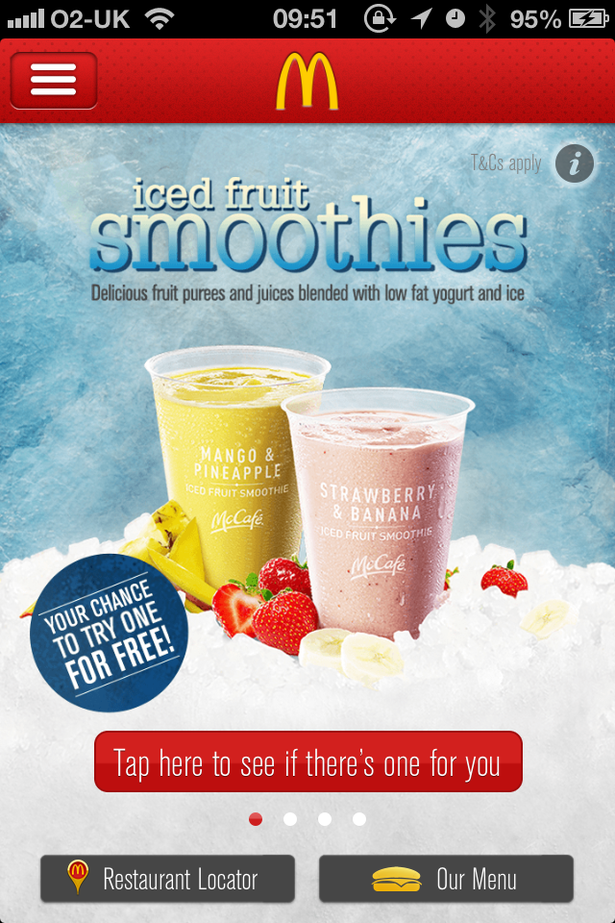
Sales of particular products such as smoothies and ice creams are highly dependent on the weather.
With the temperature rising and companies like Innocent raising the consumption of smoothie products, McDonald's wanted a way to connect with consumers looking for this type of drink.
Of note however is that the tool is not in a new app - rather, it is baked in to the app that consumers have already downloaded, with an update from the App Store changing the content.
By playing the interactive game, consumers win a free smoothie which they can redeem instore.
While this may cost something, the upsell opportunity that comes with driving footfall often results in a higher return on investment.
'Kick the Trash' Campaign
Big brands like McDonald's are always looking for ways to demonstrate their corporate social responsibility.
In response to claims that areas outside of McDonald's were dirty, McDonald's Germany came up with this campaign to encourage children and young people to dispose of litter responsibly.
Angry Birds in McDonald's China
In order to get people inside stores, McDonald's China partnered with Rovio to create an Angry Birds game that could only be played inside stores.
To make it even more interesting, particular content could only be unlocked from specific McDonald's stores, rewarding loyalty and repeat visits.
The app also allows customers to vote for their favourite McDonald's branch in China. The winning restaurant will see a gigantic Golden Arches slingshot attached to the store.
McDonald's Denmark Coinoffers App
When big brands are all doing the same things, it can be difficult to stand out.
McDonald's Denmark created a game where people could scan QR codes to collect virtual currency which they could spend on real world food at McDonald's.
On the first day alone, over 30,000 virtual coins were collected, which equals more than 3,000 cheeseburgers. For a country of only 5.5 million people, this is an impressive result.
McDonald's Free Breakfast Day
Outdoor media is somewhere where digital is also having an impact.
In Singapore, McDonald's partnered with Clear Channel to offer dynamic display advertising to alert consumers to free breakfasts at local stores.
With supplies limited, the ads showed how much stock was remaining, creating an incentive for customers to visit.
In the digital world the better you can explain your business, the better your market will be. A well chosen words can result in fortunes. Its the content that is a handy information to the prospective customers. The words, the way of presenting the same is the ages old concept but yet redefined in the digital market. The more appealing and informative the content is, the more will be its value. For More Details: www.sanicondigital.in